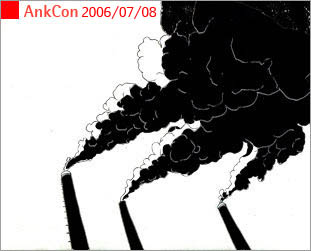
The heat is on – climate change and the oil
endgame
May 18-21, 2006
Most people are now aware of the 21st century’s twin
problems of global warming and the end of cheap oil. Media interest
is growing and we are beginning to feel the pain of the major
disclocations to be forced upon our societies – but why
is it that so little action has been taken?
Understanding the barriers to progress and how they can be
overcome will be a central theme of this year’s Ankelohe
Conversations. After bringing participants up to speed on what
Science knows so far, the symposium will address how writers and
public discourse itself can better engage with these twin challenges
to help ensure public action and the necessary policy outcomes.
In other words: Can we “dumb up” the public discourse
when it matters so much that we do? What stands in the way of
this?
Only a few years ago, calls for action against global warming
were routinely rejected as alarmist. Sceptical scientists and
industrial lobby groups argued that climate change was not yet
scientifically proven. One could wait and see a while longer.
This has changed. The broad majority of scientists and the media
now accept the mounting evidence that a possibly catastrophic
climate change is very real indeed. And yet, a mix of remnant
scepticism and what appears to be collective denial or resignation
still prevents action. Apart from a short-lived campaign in advance
of the July 2005´s G8 summit in Edinburgh, there are still
few signs that governments and society are ready to change course.
The Kyoto treaty on greenhouse gas reductions, strongly opposed
by Washington, is barely alive and may fail to get renewed.
Instead, adaptation appears to be the order of the day. After
the recent series of destructive hurricanes in the South, it was
seriously suggested in a major US newspaper that climate change
could best be coped with by building wider northbound highways
so that the population could flee future hurricanes faster.
To slow down climate change governments need to change their
energy policies - just as the world is sliding into an energy
crisis. Dwindling supplies and ever growing global consumption
of oil, which provides for nearly half of the world's energy,
may cause the price of oil to soar to unseen heights. With global
oil demand estimated to rise by another 60% from now until the
year 2020, especially in China and India, global production is
expected to peak soon, making oil unaffordable to many countries
and people.
The end of cheap oil only highlights the security aspects of
energy: In most oil-producing countries petro-wealth has not led
to sustained development but instead to corruption, political
instability, oppression, social crises, economic decline, environmental
degradation as well as bloody inter-state and civil wars. Today,
energy wars are a real threat: Following the war in Iraq, the
United States is now openly competing with China for access to
oil fields around the world.
As if the industrialised nations´ increasing dependence
on foreign oil imports was not worrying enough, much of that oil
lies in the unstable Middle East, the hotbed of radical Islamic
terrorism. Since the September 11 attacks it has become clear
how the politics of oil contribute to the rise of terrorism. Western
support for oppressive and corrupt oil sheiks has bred popular
resentment, and Saudi petrodollars have been used to fund anti-American
jihadist groups, including Al Qaeda.
Is there a way out of the energy crisis and global warming? While
some experts champion more efficient technologies to both increase
fossil fuel production and to conserve energy, others call for
an alternative energy policy shifting to decentralised solar power
and to next-generation transportation fuels such as hydrogen fuel
cells. Again others promote the expansion of nuclear power to
curb greenhouse gas emissions.
Climate change is a simmering catastrophe that few journalists
enjoy writing about, partly because it is complicated and lacks
the usual man-against-man conflict pattern. The same is true for
energy issues. Instead, most journalists prefer to cover the many
little and large straw fires of the present. Economic worries
continue to excuse lack of action. Obsession with terrorism is
the ideal diversion from a problem that is ultimately more dangerous.
Writers have a key role to play in changing this. The core questions
at the symposium will therefore be: What mechanisms are at play
in the collective failure to take climate change seriously? Why
are green policies failing? How can we write effectively about
climate and energy issues, and galvanise people and governments
into action? What scenarios exist for the global transition into
a post-oil era? If we accept that global warming and the end of
cheap oil will force major changes and dislocations on our societies
and lifestyles we need to start discussing our plans for them
now.
The symposium’s theme is explored mainly through presentations
by and discussions with renowned guest speakers such as climate
and energy experts, politicians, strategists, oil executives,
and environmental campaigners. There is also an English-style
debate which participants can join. Generally, everything said
is considered off-the-record under Chatham House rules. The standard
language for the conference is English but translation can be
arranged.
To reach a wider audience the symposium opens up for a public
panel discussion on the last evening to which about 100 guests
and media representatives are to be invited. They have the opportunity
to discuss with the participants and meet them at the garden party.
The organisers can assist guests in finding hotel accommodation
in nearby Bad Bederkesa.